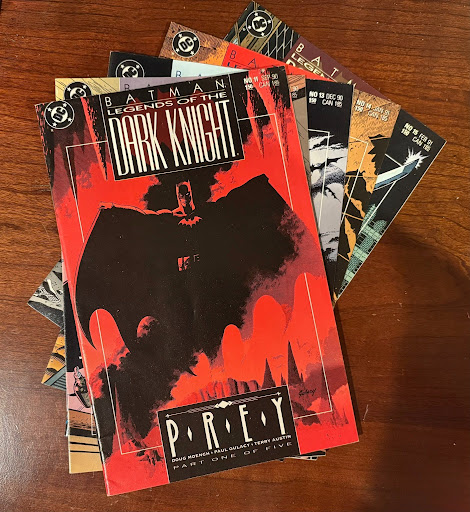
Batman: Prey is a five part comic written by Doug Moench and penciled by Paul Gulacy that was published in Legends of the Dark Knight #11-15 in the early ‘90s. This story served as the reintroduction of the classic Batman villain Hugo Strange into DC’s post-crisis continuity, a time when DC emphasized straightening out its convoluted history. Prey hasn’t been in print for a while, but I was lucky enough to find the original issues for cheap, and every now and then you could probably find a good deal on EBay or elsewhere. While not as popular as other Batman classics, Prey is held in fairly high regard, a reputation that I definitely agree with. There will be some light spoilers in this review, but probably nothing that would ruin the story.
Starting with the art, I thought that Gulacy did an excellent job throughout the whole series. The art isn’t too stylized, but it makes up for that with its consistent sense of form. Everything really feels like it takes place in a 3D space. This helps a lot with making Gotham feel like a real place, and the art really nails that grimy neonlit style that Batman artists strived for at the time. The art in this book makes the more mundane scenes as visually interesting as the mundane ones. Before reading Prey I wasn’t familiar with Gulacy at all, but am now much more inclined to look out for his stuff in the future.
While Gulacy was new to me reading this comic, I was already more familiar with Doug Moench, as I have enjoyed his other Batman stories and his work on Moon Knight (a character that he co-created). A lot is fit into Prey over its five issues, but it’s not so dense that parts feel underdeveloped. All of this stuff going on with Hugo Strange, the mayor, the GCPD, and other groups helps keep the story moving and keeps everything feeling very tense. Just one example of the tension increasing over the course of the story was Batman and Gordon’s meetings becoming more and more secretive, which made it feel extra triumphant when they could finally be in the same panel again.
When I see this book up on a website, I often see it be labeled as a mystery, which isn’t fully the case. Almost every event in the story is shown to the reader, including what the villains are up to. While this may sound unengaging, it adds to that previously mentioned tension because you have a much better grasp of what’s going on and what’s at risk. This is a problem with other comics, where they try too hard to play up the sense of mystery that it becomes hard to fully get what’s happening. As much as I love Jeph Loeb’s Batman stories, most of them suffer from this problem, where even after they end I’m still confused as to the significance of some scenes.
Prey falls back on the common trope in Batman stories where Batman winds up antagonized by the police. While this is nothing new, I think that trope was done perfectly here by injecting it with a lot of nuance. At the beginning, the push by law enforcement to capture Batman mostly involves people only doing so half-heartedly, with a few key figures holding vendettas mixed in. In particular, I think Jim Gordon’s role in being torn between the GCPD and his support of Batman was done excellently, especially compared with other comics. He constantly questions if what Batman is doing is just, but after the vigilante is framed for a crime that he didn’t commit, there is no contrived moment where they turn on each other. This really contrasted with portrayal in Year Two, which chooses to opt for cheap tension between the two men.
Something notable about Prey compared to modern comics is the sheer amount of words on a page. Before writing this, I flipped through the first volume of the much more recent Absolute Batman and, except for a couple times when Alfred is monologuing, it is night and day between the two books. I feel like usually it is more of a negative when comics are more verbose than they have to be, because that implies a lack of faith in the art’s ability to tell the story. I don’t think that is a problem in Prey, however. Even though there is a lot of writing, it is never redundant like a Stan Lee comic, and in general I think that the way that dialogue is spread across the page better helps guide your eyes and pace the span of time in a panel. This is also why the comic gets away with being so dense, because it doesn’t have to struggle as hard against an individual issue’s page count. I like wordless panels a lot, but I think that some modern comics overuse them to the point that they lose their impact. Here, though, it feels much more significant when the dialogue stops during a moment of intense action. Going back to how the story is kind of like a mystery that you know the most of the answers to, the quantity of dialogue and narration also aids in letting the reader in on each character’s thought process, so that when they finally come to a conclusion it doesn’t seem like they are making a massive leap. There is nothing inherently better about having a lot of words on a page in a comic versus having a sparse amount, but the fact that the latter is the current style draws me more to the former.
The main villain of Prey is Hugo Strange, who primarily because of this story has become one of my favorite Batman villains. I always prefer Batman villains that aren’t physical threats, and that aspect is made into a core part of Strange’s character here. I also think that too many smart characters are portrayed as scientist-types, so I’m glad that in this comic Moench pivoted from the character’s established mad scientist angle and made him into more of a psychologist. Even though he is meant to be intelligent, his dumb moments don’t feel contrived because of how they are informed by his own insecurities. What is probably my favorite part of Strange in this is that he is a villain that Batman can’t just arrest. A lot of what he does, particularly in the story’s first half, is within the law, and I think that is such an interesting route to take for a character that is unambiguously evil.
A lot of Batman stories try going for the title of being the definitive follow up to Year One. Of the ones that I’ve read, Prey is probably the most deserving. One thing that it does well is in how it ups the ante in a believable way. As much as I love The Long Halloween, it is way too big a jump by having most of Batman’s rogues gallery, especially the more fantastical ones like Poison Ivy and Solomon Grundy, already established. In Year One, Batman faces off against gangsters and corrupt members of the police force, so I feel that there should be a more gradual progression of threats. The Man Who Laughs does better in feeling like it could take place shortly after Year One by telling the story of Batman’s first encounter with the Joker. However, the problem with that comic is that, in my opinion, its hook is the most interesting thing about it, and it overall isn’t very memorable. The previously mentioned Year Two is a poor successor to the original because its story doesn’t do much to justify it being set early on in Batman’s career, among its other flaws. Prey does well in following up Year One by using Catwoman and Gordon in mostly similar ways, introducing key parts of the Batman mythos like the Batmobile and Batsignal, as well as keeping a similar tone. I think that Hugo Strange was also the perfect villain for a story that bridges the gap between Year One and the more traditional idea of Batman, as he is a classic Batman rogue, while not being too out there.
I don’t think that “underrated” is the proper word to describe Prey, because when I see it brought up online it is well regarded, but I don’t see it brought up too much and it being out of print seems to indicate the book being overlooked to some degree. I would heavily recommend that more people try reading this comic, as it is already excellent by itself, and it gets even better with how well it ties in with other Batman stories. The Batman drew a lot of attention to the story Batman: Ego by citing it as one of its main influences. Prey fits tonally with that first movie, so I could definitely see the next movie looking to it for influence. That would not only result in a great new movie, but would also inspire more people to check out this book.