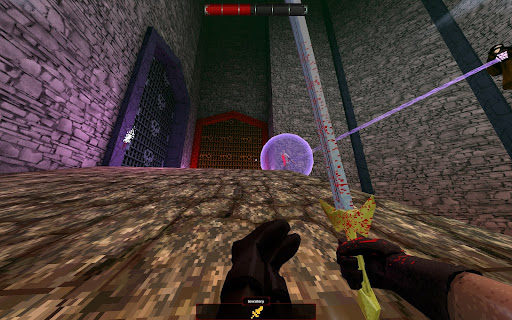
Bloodthief is a game that I did not expect to enjoy as much as I have. I found out about the game from the YouTube devlog created by the game’s developer, Blarggis. I am often frustrated by other video series documenting a game’s development because they usually place too much emphasis on the game’s ideas or the video’s entertainment value. What set this devlog apart was that it did those things while also explaining the technical process of game development, which was what I was really interested in. Still, Bloodthief didn’t really look like a game that appealed to me, because I’m not too big a fan of this game’s inspirations, like Quake or Ultrakill. However, I eventually decided to give the demo a try and ended up playing the available levels over and over again. Eventually, I bought and completed the full game, and I would absolutely recommend it.
The main point of the game is to run through levels as fast as possible using abilities like slides and airdashes that cost blood from enemies. Blood is also used for your health, making it especially important to keep track of and maintain it when fighting enemies. In addition to the core set of abilities, there are many weapons that have pretty significant gameplay effects when equipped. Because most of the game’s fun comes from beating your own times, it has essentially infinite replayability. In addition to racing yourself, there are multiple tiers of medals on each level that are unlocked after beating specific times. There is even a hidden tier called the “Godkiller” medal, which is achieved when beating the developer’s time on a level. The few times when I managed to plan out and execute on a fast enough route to get a Godkiller medal were very satisfying. Overall, I have found it very enjoyable and fulfilling to slowly improve my records on each level over time.
While the game is mostly based around speedrunning, there is a smaller exploration aspect. Each level is filled with numerous secrets that range from helpful boosts to get you through the level (e.g., unlimited blood or an explosive airdash), or artifacts that unlock new weapons. Sometimes, the search for these secrets feels rewarding, but after a while, it just feels tedious. There is one weapon that lights up when near a secret, but I don’t find it too useful because it still lights up for already collected secrets, and it isn’t helpful at all in the more winding, snakelike levels. At this point, I’ve accepted that secret hunting isn’t what I value in this game, and I’ve just started using a guide to find what I’ve missed.
There are 30 main levels in Bloodthief, with some extra secret ones as well. As of writing, I have found all of them yet, so I’m not quite sure how many there are. The levels in this game are incredibly varied. Some are based purely around speed, while others place more emphasis on combat. Some focus more on the airdash, while others focus more on the slide. Some are a straight shot to the finish, while others make you plan your own path to collect keys. Every level has its own identity that makes it memorable. There were a few that stood out as particularly challenging, but nothing that came off as overly frustrating. A game like this rides or dies based on its level design, and thankfully, Bloodthief knocks this aspect out of the park.
A weirdly small aspect of this game was the boss fights. Somewhere in the second half of the game, the player encounters their first boss. This would seem to imply that there would be more throughout the game, but (unless there are more in the secret levels), the only other one was in the very last level. The final fight was also just decent, and probably one of the weaker levels. I am glad that boss fights weren’t shoehorned into other parts when the focus should be on speed, but that just makes it all the more strange that they were even included in the first place.
The game’s story is also worth mentioning. If you go through Bloodthief, only focused on the gameplay, you will get a vague but good enough understanding of what is going on. Most of the game’s actual story is hidden away in journals inside the levels or in the descriptions of artifacts. This Dark Souls-inspired way of conveying the story serves it well, because it doesn’t slow people down who aren’t interested, while still giving something to the players who are.
Bloodthief was a very pleasant surprise. Even though it struggles in aspects that aren’t its strong suit, like the exploration or boss fights, it absolutely excels at its speedrunning core. Even after I find all of the game’s secrets and achieve at least the diamond medal on (most) levels, I’m sure that I’ll still return to this game every so often. If you still aren’t entirely sold on Bloodthief, do yourself a favor and at least give the demo a try.